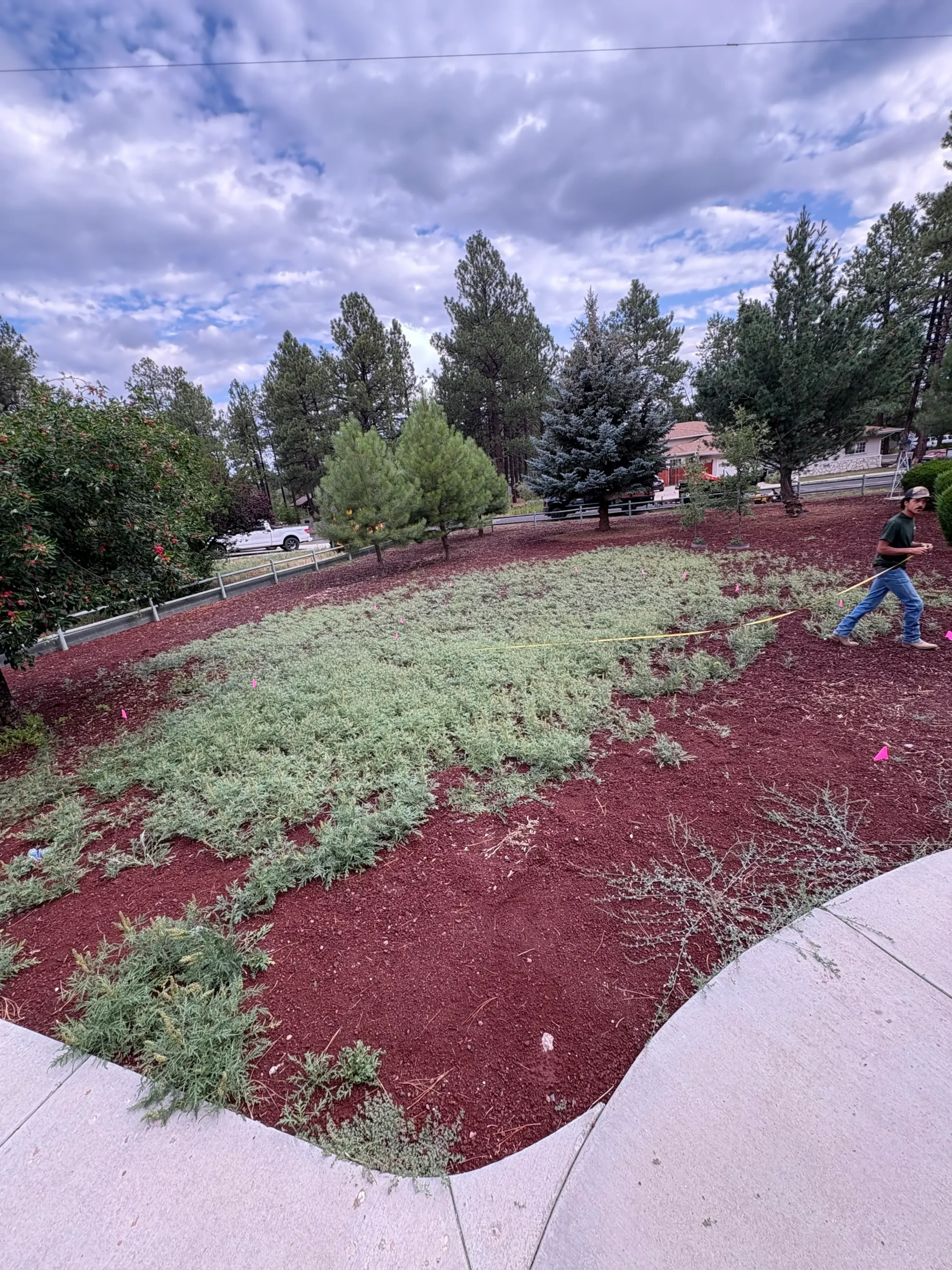
You put down gravel. You were told it would be low maintenance. Now, every spring, it’s full of weeds — and every year the problem seems to get worse, not better. You’re not imagining it, and it’s not because gravel is bad. It’s because weeds in gravel yards almost always come from a specific set of fixable causes, and most people never address the right ones.
Here’s what’s actually going on, and what works versus what doesn’t.
The real reason weeds grow in gravel
Most people assume weeds in gravel are coming up through the ground — and sometimes they are. But the majority of weeds in an established gravel yard aren’t growing from the soil below. They’re growing from seeds that blew in from outside and germinated in the layer of dust, organic debris, and fine particles that accumulates on top of the rock over time.
In Flagstaff, this problem is amplified. Pine needles, leaf debris, pollen, and windblown soil settle into gravel constantly — especially in yards surrounded by ponderosa pines. Over a few seasons, that accumulation creates a thin but sufficient growing medium right on the surface of your rock. Weeds don’t need much. A handful of decomposed debris and a little moisture is enough to germinate most common Flagstaff weeds.
This means that even a perfectly installed gravel yard with commercial-grade landscape fabric underneath will eventually develop surface weeds if the top layer isn’t maintained. The fabric controls weeds from below. Nothing controls the ones germinating on top.
The five most common reasons your gravel has weeds
The landscape fabric underneath is the cheap stuff
This is the most common problem we see — and the one most homeowners don’t know about until it’s too late. The woven polypropylene fabric sold in rolls at Home Depot, Lowe’s, and most big-box stores looks fine on install day. Within 2–4 years in Flagstaff’s UV and freeze-thaw environment, it breaks down. Roots from established weeds punch through it. It tears and shifts. Once it fails, weeds from the soil below come up freely — right through the gravel.
The cheap fabric isn’t just less effective. It’s actively worse than no fabric at all in some cases, because once roots grow through it they anchor and become very difficult to remove. You end up with weeds that are entangled in a disintegrating fabric layer that’s now impossible to dig out cleanly.
What to look for instead: Commercial-grade non-woven geotextile fabric — the kind used in road and drainage construction. It’s heavier, UV-stabilized, and rated for decades of use rather than a few seasons. It costs more per roll but it’s not even close to the same product. We use it on every install.
The fabric wasn’t installed properly
Even good fabric fails if it’s installed with gaps, improper overlaps, or inadequate edging. Common mistakes include leaving gaps around plants, not overlapping seams by at least 6–12 inches, and not securing edges so the fabric doesn’t pull back over time. Any gap is an invitation. Tree roots and ground squirrels also displace fabric over time — a clean install in year one can have significant voids by year three.
Surface debris has built up
As described above — pine needles, dust, and organic material accumulate on top of gravel and create a surface growing medium. This is especially pronounced in Flagstaff under ponderosa canopy. A yard that was weed-free in year one often develops surface weeds by year three simply from debris accumulation, with no fabric failure involved at all.
The solution here is maintenance, not reinstallation. Regular blowing or raking to clear surface debris before it breaks down, combined with a pre-emergent application in spring, dramatically reduces surface weed pressure.
No pre-emergent was applied — or it was applied too late
Pre-emergent herbicide is one of the most effective tools for gravel weed control and one of the most misused. It works by preventing weed seeds from germinating — it does nothing to weeds that are already established. Timing matters enormously: it needs to go down before soil temperatures warm enough for weed seeds to germinate, typically late March to mid-April in Flagstaff. Most homeowners apply it after they see weeds, at which point it’s useless for that season.
Applied correctly in spring (and often again in early fall for cool-season weeds), a quality pre-emergent reduces weed germination by 80–90%. Combined with good fabric, it’s the most effective weed control system available.
The gravel layer is too thin
Gravel needs to be at least 3 inches deep to suppress surface weed germination effectively. Installations that use less — often because the homeowner bought less material to save money — leave the fabric visible in spots and provide insufficient coverage to block light from reaching germinating seeds. Over time, settling reduces depth further. A fresh top-dress of rock every few years helps maintain effective depth and refreshes the look.
The weed barrier truth: not all fabric is the same
We can’t say this clearly enough: the landscape fabric sold in big rolls at Home Depot and Lowe’s is not a long-term weed barrier. It is a short-term weed delay. The product is typically a lightweight woven polypropylene rated for 3–5 years in ideal conditions. Flagstaff’s UV intensity at 7,000 feet, combined with freeze-thaw cycling through winter, degrades it faster than that — often in 2–3 years in exposed areas.
| Fabric type | Works long-term? | Lifespan in Flagstaff | Cost |
|---|---|---|---|
| Big-box woven poly (Home Depot, Lowe’s) | No | 2–4 years before failure | Low upfront, high long-term |
| Mid-grade woven landscape fabric | Marginal | 4–7 years with good UV rating | Moderate |
| Commercial non-woven geotextile | Yes | 15–25+ years | Higher upfront, lowest long-term |
| No fabric (rock direct on soil) | No | Weeds from day one | Lowest upfront, highest long-term |
When we install gravel, we use commercial-grade non-woven geotextile — the same category of fabric used under roads, in drainage systems, and in commercial construction. It doesn’t break down under UV. Roots don’t penetrate it. It lasts the life of the landscape. The cost difference on a typical residential project is a few hundred dollars. The difference in performance over 10 years is enormous.
Already have cheap fabric that’s failing? If you have an established gravel yard with disintegrating fabric underneath, the most practical fix is usually to grade the surface, remove the worst of the old fabric where accessible, install commercial geotextile over it, and top-dress with fresh rock. A full dig-out and reinstall is expensive and often unnecessary — a proper overlay is the right call for most properties.
What actually works: a complete weed control system
No single thing eliminates gravel weeds permanently. What works is a layered system:
1. Commercial geotextile fabric, properly installed with overlapping seams, secured edges, and proper cutouts around plants. This controls weeds coming up from the soil below.
2. Minimum 3 inches of rock, topped up every few years as settling reduces depth. This provides light blocking and surface suppression.
3. Pre-emergent applied in early spring — before you see any weeds, before soil temperatures climb above 50°F. In Flagstaff, that’s typically late March to mid-April. A fall application for cool-season weeds helps year-round.
4. Regular debris clearing — blowing or raking pine needles and organic material off the surface before it breaks down into a germination layer. In Flagstaff, this means at minimum a spring and fall pass, and ideally more frequent maintenance under heavy tree canopy.
5. Spot treatment of any weeds that do establish, before they go to seed. One mature weed can drop hundreds of seeds into your gravel. Pulling or treating before seed set is far more effective than any other intervention.
Our maintenance plans include pre-emergent timing. Getting the application window right is one of the most common places homeowners miss. Our landscape maintenance plans include properly timed pre-emergent application as standard — so you’re not guessing at the calendar.
A note on weed killers
Post-emergent herbicides kill weeds that are already growing. They’re useful for spot treatment but shouldn’t be your primary strategy in a gravel yard. More importantly — most of what homeowners reach for doesn’t work the way they think it does.
There are two fundamentally different types of post-emergent herbicide, and most people don’t know the difference:
Contact/burn-down herbicides — products like diquat (found in many fast-acting “weed and grass killers” at big-box stores) work by burning the plant tissue they touch. The weed scorches and browns within a day or two, looks dead, and you think the job is done. The problem is that established weeds in Flagstaff gravel beds almost always have deep, intact root systems. The top burns. The root survives. Within two to four weeks the weed regrows from the same root, and the cycle repeats all season. These products work well on very young annual weeds caught early — germinating seedlings and shallow-rooted grasses. On anything established, they’re largely cosmetic.
Fast-acting ≠ effective. If a weed killer shows results in 24 hours, it’s almost certainly a contact product. It’s burning the top of the plant, not killing the root. For perennial weeds with established root systems — bindweed, thistle, dandelion, spurge — you’ll be spraying the same weeds every few weeks all summer.
Systemic herbicides — glyphosate (Roundup and its generics) is the most widely available example. Unlike contact killers, glyphosate is absorbed through the foliage and travels through the plant’s vascular system down into the root. It takes longer to show results — 7–14 days — but it actually kills the whole plant, not just the visible growth. For established perennial weeds, glyphosate is significantly more effective than fast-acting burn-down products. It’s slower and looks less satisfying at first, but the weed doesn’t come back.
The practical takeaway: if a weed looks dead in 24 hours, it probably isn’t. For young annual weeds caught early, fast-acting products are fine. For anything perennial and recurring, glyphosate or a broadleaf-specific systemic product is the right call. And in either case — post-emergent treatment is always a last resort, not a strategy. A properly installed system with commercial fabric and pre-emergent means you’re rarely reaching for herbicide at all.
The best of both worlds: blended products with a surfactant. The most effective spot-treatment option for established gravel yard weeds is a product that combines a contact agent, a systemic agent, and a surfactant in one formula. The contact component gives you visible browning within 24–48 hours so you know the product hit the plant. The systemic component travels to the root and kills it properly. The surfactant — a soap-like additive — helps the formula stick to and penetrate waxy or hairy leaf surfaces that would otherwise shed a standard spray. Products like Gordon’s Trimec or similar professional blends work on this principle. You get the satisfaction of fast visible action and the thoroughness of root kill in a single application — which is why professional crews use blended products rather than single-chemistry consumer sprays.
Broadcast spraying of any herbicide repeatedly over gravel areas can also affect nearby desirable plants and creates chemical runoff during monsoon rain. Use them as a targeted spot tool, not a substitute for the fabric and pre-emergent system described above.
Frequently asked questions
If your gravel yard is a constant battle, it’s almost never the rock itself — it’s the system underneath and the maintenance routine. Getting those right turns a frustrating yard into a genuinely low-maintenance one.
Serving homes and businesses across Flagstaff, Williams, and Northern Arizona.
Get in touch Call 928 202 0713