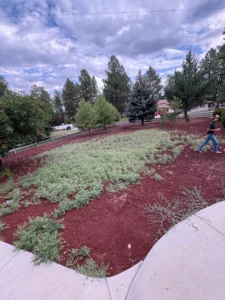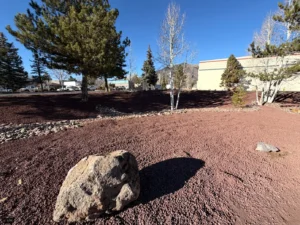
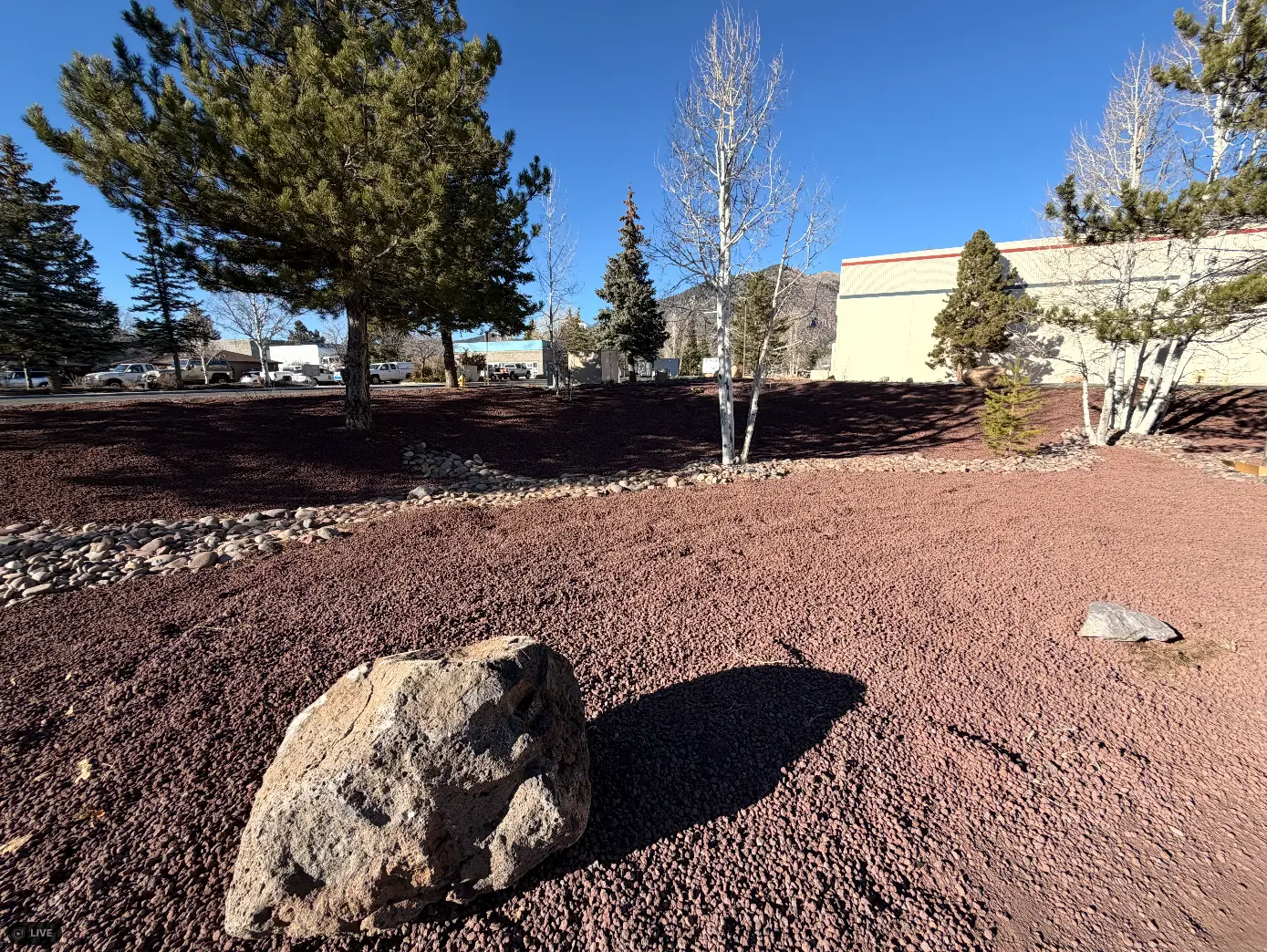
Cinders are one of the most common landscaping materials in Flagstaff — and one of the most regretted. You see them everywhere: reddish-burgundy gravel spread across front yards, usually topped with a few boulders and some struggling plants. They’re cheap, they’re widely available, and they look decent on install day. The problems start about six months later.
We remove a lot of cinders. We also field a lot of calls from homeowners who are tired of theirs and want to know what to do. This post is the honest version of what we tell them — what cinders actually are, why they cause so many problems at Flagstaff’s elevation specifically, and what works better.
What are cinders, exactly?
What most people call “lava rock” in Flagstaff is actually volcanic cinders — lightweight, porous, reddish-brown material mined from ancient cinder cones. It’s the same geological material as lava rock sold in Phoenix, but the local variety tends to be even more fragile. The porous structure that gives cinders their distinctive look is also what makes them problematic: they’re full of tiny air pockets that trap water, debris, and eventually break down under pressure and freeze-thaw cycles.
True decorative lava rock — the heavier, denser red or black basaltic material — is a different product and holds up somewhat better. Most of what gets installed in Flagstaff yards under the name “lava rock” is the lighter cinder material, and that’s where the problems live.
Problem 1: They break down fast at elevation
Flagstaff’s freeze-thaw cycle is relentless — over 100 cycles per year where temperatures drop below freezing overnight and climb above during the day. Water seeps into cinders’ air pockets, freezes and expands, then thaws. Every cycle chips away at the structure of the material. Within a few seasons, cinders that looked sharp and defined on install start crumbling into a fine reddish dust that mixes into your soil and blows around your yard.
Once cinders break down into your soil, they’re essentially permanent. The fine material mixes in thoroughly and cannot be separated. Any future planting, grading, or material change has to work around contaminated soil. This is the number one regret we hear from homeowners who had cinders installed years ago.
Dense, non-porous materials — Malapai basalt, river rock, or Table Mesa Brown — don’t have this problem. They don’t have internal air pockets to trap water, so freeze-thaw cycles leave them essentially unchanged for decades.
Problem 2: They go everywhere
Cinders are light — that’s part of their appeal as a low-cost material, since transport is cheap. But lightweight means they move. Flagstaff’s wind picks them up and deposits them on driveways, walkways, and in the street. Monsoon rain pushes them downslope and washes them into drainage channels. Kids and pets track them inside constantly. After a winter of snowplowing, they end up mixed into snow piles, scattered across the driveway, and sometimes in the gutter a block away.
Every spring we see the same thing: cinder yards that looked contained in October are spread across the surrounding hardscape by April. Heavier materials — anything with more density — simply stay where you put them.
Problem 3: They trap debris and create fire risk
Cinders’ porous, jagged surface is excellent at catching pine needles, dead leaves, and windblown organic debris — exactly the material Flagstaff properties produce in volume. That debris settles into the rock, can’t be blown off easily, and builds up into a layer of combustible material mixed through the cinders.
Firewise concern: Flagstaff’s Firewise guidelines call for non-combustible materials in Zone 1 (0–5 feet from the structure). Cinders themselves are non-combustible, but a cinder bed full of trapped pine needle debris is not. Smooth, dense materials like Malapai shed debris cleanly and are far easier to maintain as a true fire-safe surface.
Problem 4: Weeds still grow — and are miserable to pull
A common reason people choose cinders is weed suppression. The reality: cinders suppress weeds no better than any other loose material, and weeds that do establish are significantly harder to remove. The jagged surface shreds your hands even through gloves. Roots anchor deeply through the gaps into the soil below. Weeds often snap off at the surface rather than pulling clean, which means they regrow.
Over time, as cinders break down and mix with soil, the weed problem gets worse — not better. You end up with a layer that’s part rock, part fine reddish dust, part soil, and impossible to maintain cleanly.
Problem 5: They look messy fast
Fresh cinders have a clean, defined look. Within a year or two in a Flagstaff yard, that look deteriorates. The color fades and dulls under high-altitude UV. The surface gets patchy as material blows away or breaks down unevenly. Debris accumulates in the gaps and doesn’t clear. Pine needle staining turns sections brown. The overall effect is a yard that looks neglected even when it isn’t.
Dense materials hold their color and surface appearance for decades because there’s no internal breakdown and the smooth surface stays clean.
So when do cinders make sense?
We’re not saying never. Here’s where cinders actually work and where they don’t:
| Use case | Cinders? | Notes |
|---|---|---|
| Front yard ground cover | No | Breaks down, fades, migrates — use Malapai or Table Mesa Brown |
| Zone 1 near structure | No | Debris trap, Firewise concern — use smooth dense rock |
| Driveways | No | Gets tracked everywhere, breaks under tire pressure |
| Drainage areas | No | Too light, washes away in rain — use river rock |
| Fire pit base material | Yes | Contained, non-combustible, drains well — works fine here |
| Utility or back-of-property areas | Maybe | Low visibility, low stakes — acceptable if budget is the priority |
| Decorative accent around boulders | Maybe | Small contained areas with edging fare better than large open beds |
What we recommend instead
Malapai is the most popular alternative and for good reason. It’s dark volcanic basalt — dense, freeze-thaw resistant, debris-shedding, and looks sharp for decades. If you want the dark volcanic look that cinders promise but never deliver long-term, Malapai is what actually delivers it.
For warmer tones, Table Mesa Brown and Palomino Gold perform well and hold their color. If you specifically want that reddish-brown palette, cinnamon gravel gives you a similar warmth without the breakdown. River rock is the right call for drainage features and dry creek beds where weight and stability matter.
Already have cinders and want to replace them? The honest answer is that full removal is difficult once they’ve started breaking down into the soil. The most practical approach is to grade the surface, add a quality weed barrier, and install a denser material on top — essentially burying the problem under something that won’t have the same issues. We can walk you through the options for your specific situation. Get in touch here.
Frequently asked questions
If you have cinders and are ready to do something about them — or if you’re planning a rock install and want to avoid this problem from the start — we’re happy to come take a look and give you a free rendering of what the alternatives would look like on your actual yard.
Serving homes and businesses across Flagstaff, Williams, and Northern Arizona.
Get a free rendering Call 928 202 0713