If you’ve ever tried to grow a garden in Flagstaff and watched something that thrives everywhere else just give up and die, you’re not imagining things. Flagstaff soil is genuinely hard to work with — and for reasons that aren’t obvious if you’ve never gardened at 7,000 feet before.
The good news: once you understand what you’re dealing with, there’s a lot you can do. Here’s a straightforward breakdown of why Flagstaff soil behaves the way it does, and what actually helps. If you’re also dealing with weeds pushing through your gravel yard, soil chemistry is often part of that problem too.
What makes Flagstaff soil so challenging
It’s built on volcanic cinder
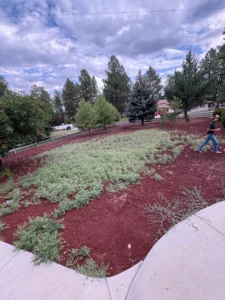
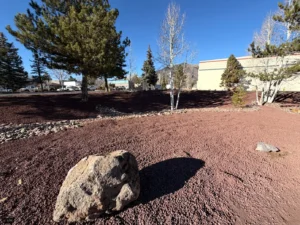
Northern Arizona sits on one of the most volcanically active regions in the continental United States. The San Francisco Peaks, Sunset Crater, and hundreds of surrounding cinder cones left behind a landscape dominated by volcanic basalt and cinder. If you’ve used lava rock or cinders in your landscaping, you’ve already seen firsthand how fast that material drains.
Cinder is essentially porous rock. It drains extremely fast — sometimes too fast — and holds almost no nutrients on its own. When plants can’t access water or minerals, they struggle regardless of how much you water or fertilize.
Organic matter is nearly absent
Healthy soil in most parts of the country contains 3–5% organic matter. Flagstaff’s native soils often come in under 1%. Without organic matter, soil can’t hold moisture between waterings, beneficial microbes have little to work with, and nutrients leach out before roots can absorb them.
The ponderosa pine factor: Pine needles decompose slowly and can slightly acidify the soil beneath them — fine for the pines, but they don’t build the kind of rich humus that a deciduous forest floor would. You’re not getting free compost from your trees.
pH is all over the place
Flagstaff soils tend to run alkaline — often between 7.5 and 8.5 on the pH scale. Alkaline soil locks up key nutrients like iron, manganese, and zinc, making them chemically unavailable to plants even when those nutrients are technically present. This is why Flagstaff gardeners often see yellowing leaves (chlorosis) on plants that have been fertilized regularly.
Soil pH in the region isn’t uniform either. Spots near old volcanic activity can run quite differently from areas with more clay or sediment influence. You genuinely cannot assume your soil matches your neighbor’s. The University of Arizona Cooperative Extension has good regional resources on this.
Elevation changes everything
At 7,000 feet, the rules of conventional gardening don’t fully apply. The growing season is compressed — Flagstaff averages 100 to 130 frost-free days per year, compared to 200+ in Phoenix. Intense UV radiation at altitude stresses plants more than at sea level. Soils warm slowly in spring and cool quickly in fall, affecting root development and soil biology throughout the season.
Even if you fix the soil chemistry, altitude puts extra pressure on plants that weren’t bred for high-elevation conditions. The current weather pattern in 2026 is also affecting soil moisture levels across Northern Arizona — worth factoring in if you’re planning amendments this season.
What you can actually do about it
Start with a soil test — don’t skip this
Before spending money on amendments, get your soil tested. The University of Arizona Cooperative Extension offers soil testing resources for Arizona residents, and several mail-in labs provide detailed reports for $20–$40. A good test will tell you your pH, organic matter content, nutrient levels, and often give amendment recommendations specific to your results. Guessing costs more in the long run.
Pro tip: Test soil from multiple spots on your property. Flagstaff soil can vary significantly from one corner of a yard to another, especially near old tree stumps, drainage areas, or slopes.
Amend with organic matter — repeatedly
Adding compost is the single highest-impact thing you can do for Flagstaff soil. A 3–4 inch layer worked into the top 12 inches of a new bed makes an immediate difference. But one application isn’t enough — plan to top-dress with compost every spring and fall. Organic matter breaks down faster in Flagstaff’s dry, sunny conditions, so you’re constantly playing catch-up. Our landscape maintenance plans include seasonal bed prep to take this off your plate.
Adjust pH strategically
If your test shows highly alkaline soil (above 8.0), sulfur is the most effective long-term amendment to bring it down. Work elemental sulfur into the soil in fall — it reacts slowly with soil bacteria over winter and spring. Plan for the shift to take 6–12 months; soil pH doesn’t change overnight.
For faster results in planting beds, acidic mulches like pine bark or well-aged pine needle compost can help moderate pH at the surface level. The USDA’s soil health resources are a solid reference if you want to go deeper on amendment chemistry.
Choose amendments that address drainage AND retention
Cinder-heavy soil drains so fast that water moves through before roots can use it. Biochar — charred wood material — is an excellent amendment for Flagstaff conditions because it improves water retention in fast-draining soils while also supporting soil microbes and lasting for decades without breaking down. Mix it with compost for best results.
Avoid adding sand to clay-heavy spots. Counterintuitively, sand plus clay creates a concrete-like texture. Organic matter is almost always the better fix, regardless of what texture problem you’re dealing with.
Mulch heavily and consistently
A 3–4 inch layer of mulch over your planting beds slows evaporation in Flagstaff’s dry air, moderates soil temperature swings between hot days and cold nights, and gradually breaks down to add organic matter. Wood chip mulch from an arborist is ideal — often free and excellent for soil biology. Keep mulch a few inches away from plant stems to prevent rot. The same principle applies in gravel yards — organic debris accumulating on the surface is what feeds weed germination.
Work with native and adapted plants
The most sustainable approach to difficult soil is choosing plants that evolved in similar conditions. Native species like Apache plume, rabbitbrush, cliffrose, and penstemon don’t just survive in cinder-based, alkaline, fast-draining soil — they’re adapted to it. Less amending, less supplemental watering, and fewer surprises. See our full guide to plants that thrive in Flagstaff yards for a complete breakdown by plant type.
Build raised beds for food gardens
If you’re growing vegetables or herbs, raised beds are often the most practical solution. Fill them with a mix of quality topsoil, compost, and vermiculite or perlite — essentially building the soil you want rather than fighting what’s there. A good raised bed mix at altitude should have excellent drainage but enough body to retain moisture through Flagstaff’s dry spells between monsoon rains. If you need help designing and installing raised beds as part of a larger landscape project, we handle that too.
Frequently asked questions
Flagstaff soil isn’t broken — it’s just not built for the kinds of plants most gardening advice assumes you’re growing. Once you understand the volcanic foundation, the missing organic matter, and the elevation challenges, the fixes become logical: test before you amend, add compost aggressively and repeatedly, address pH based on actual data, mulch heavily, and lean into plants that were made for this landscape.
Serving homes and businesses across Flagstaff, Williams, and Northern Arizona.
Get in touch Call 928 202 0713